
Bluffing Holdem Poker: Complete Guide To Bluffing Strategies
Bluffing holdem poker is an important strategic element that allows players to compete even when their cards are not particularly strong. Successful bluffing depends on timing, table position, opponent tendencies and the overall action throughout a hand. This guide from hitclub explores the fundamental concepts, practical approaches and common mistakes worth understanding.
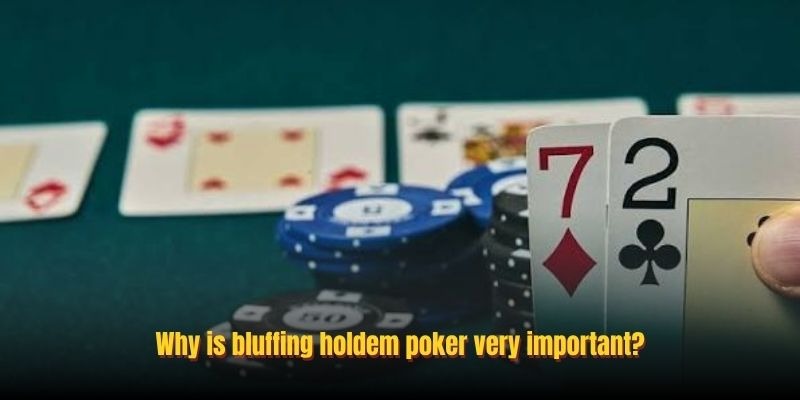
Why is bluffing holdem poker very important?
Bluffing holdem poker is an important concept because it demonstrates how players can make decisions based on incomplete information rather than relying only on the strength of their cards. Understanding the idea also helps beginners in hitclub recognize how psychology, uncertainty and strategic communication shape decisions during a poker hand.
It adds a psychological dimension to the game
Bluffing introduces an element of uncertainty because opponents cannot always determine whether a player’s actions reflect a strong or weak hand.
- Players must interpret actions rather than relying exclusively on visible cards.
- Betting behavior can influence how opponents perceive a particular situation.
- Different playing styles can create very different interpretations of the same action.
It demonstrates the importance of incomplete information
Texas Hold’em involves hidden information, making uncertainty one of its defining characteristics.
- Each player knows their own private cards but not their opponents’ holdings.
- Community cards gradually provide additional information throughout a hand.
- Decisions therefore involve interpreting possibilities rather than knowing the complete situation.
It highlights strategic balance
A player who always behaves predictably can become easier for opponents to understand. Bluffing holdem poker illustrates why varying decisions can make a player’s overall approach less transparent. From an educational perspective, studying this concept helps explain why poker strategy involves balancing different types of actions rather than following one fixed pattern.
Why is bluffing holdem poker very important?
It encourages observation and critical thinking
Understanding bluffing also requires players to pay attention to the broader context of a hand.
- Observe how different actions affect the developing situation.
- Consider how incomplete information influences possible interpretations.
- Distinguish between assumptions and information that is actually available.
- Review decisions afterward to understand alternative possibilities.
It helps explain modern poker theory
Bluffing is closely connected with broader concepts such as ranges, probability and game theory.
- Ranges: represent possible hands rather than one assumed holding.
- Probability: helps describe uncertainty mathematically.
- Game theory: examines how competing decisions interact.
- Information: highlights the difference between known and unknown factors.
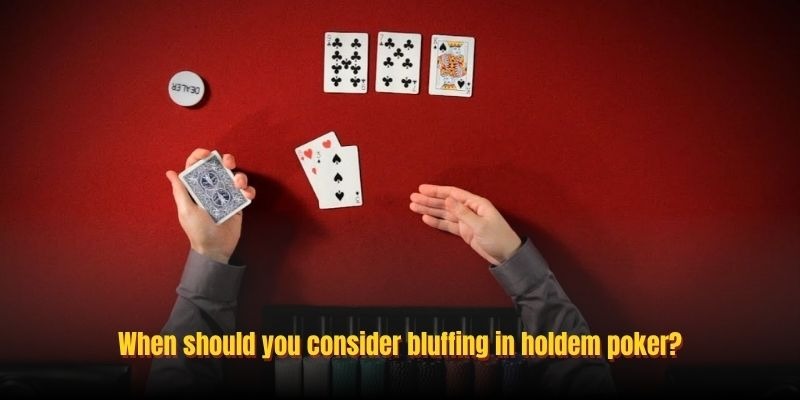
When should you consider bluffing in holdem poker?
Bluffing holdem poker is best understood as a strategic concept involving uncertainty, opponent perception and the changing context of a hand. Rather than treating bluffing as an automatic move, it is more useful to examine the surrounding information and understand why certain situations appear more suitable than others.
| Situation | Why it may matter | What to consider |
| Favorable board texture | Some community-card combinations can make particular strong hands more plausible. | Consider which hands the board realistically represents and how the action developed. |
| Opponent shows weakness | Passive or cautious actions may provide information about the range an opponent could hold. | Avoid assuming weakness from a single action; consider the entire sequence. |
| Strong table position | Acting later can provide more information about previous decisions. | Position changes the amount of available information, but does not guarantee a successful bluff. |
| Consistent story | A believable betting pattern can represent a coherent hand throughout the sequence. | The actions should make sense together rather than appearing random or contradictory. |
| Opponent tendencies | Different players interpret pressure and uncertainty in different ways. | Observe general playing patterns without assuming every opponent behaves identically. |
| Appropriate risk level | Bluffing involves uncertainty, so understanding potential consequences is important. | Keep the decision educational and avoid treating any outcome as guaranteed. |
When should you consider bluffing in holdem poker?
How to improve your bluffing holdem poker skills
Improving bluffing holdem poker skills is mainly about understanding decision-making, probability and opponent behavior rather than simply attempting to deceive other players. A structured learning process can help beginners recognize patterns, evaluate uncertainty and understand why certain actions make sense in different situations.
Study hand ranges and board textures
Understanding possible hand combinations provides a stronger foundation for interpreting what could realistically be held.
- Learn how starting-hand ranges change according to position.
- Examine how different community cards affect possible combinations.
- Compare strong, marginal and speculative holdings in different scenarios.
- Practice identifying which hands a particular board could reasonably represent.
Review previous hands objectively
Post-hand analysis can reveal assumptions or gaps in reasoning that are difficult to notice while playing.
- Record interesting hands and review the decisions afterward.
- Ask what information was actually available at each stage.
- Compare your original interpretation with alternative possibilities.
- Focus on the quality of the decision rather than whether the final result was positive.
Practice reading betting patterns
Betting sequences provide useful information about how a hand may have developed, although they should never be treated as definitive proof. Bluffing holdem poker becomes easier to understand when players learn to connect individual actions with the broader sequence of a hand. Studying different scenarios can also demonstrate how the same action may have different meanings depending on position, board texture and previous decisions.
Learn from probability and game theory
A basic understanding of mathematical concepts can make poker analysis more structured.
- Study probability to understand uncertainty between possible outcomes.
- Learn the concept of expected value as a theoretical decision-making tool.
- Explore balanced strategies and why predictable behavior can become exploitable.
- Use simplified examples before attempting to understand more complex situations.
Build a disciplined learning routine
Consistent study is more useful than trying to memorize isolated bluffing tricks.
- Review a small number of hands regularly.
- Compare different possible interpretations of the same situation.
- Study reputable educational materials and poker terminology.
- Use hitclub as a context for exploring poker concepts while keeping real-money gambling separate from skill development.
>> Read more: Hướng dẫn rút tiền hitclub
How to improve your bluffing holdem poker skills
Conclusion
Understanding bluffing holdem poker requires patience, observation and a willingness to examine each decision from multiple perspectives. Rather than relying on guesswork, players can improve their understanding by studying ranges, board textures, probability and betting patterns. hitclub can be a reference point for exploring more poker terminology, rules and strategic concepts.